The demand for skilled visual effects professionals is growing as films, web series, advertisements, gaming content, and digital media increasingly depend on high-quality visuals. For students and creative professionals who want to build a career in this field, choosing the right VFX Course in Delhi can be an important first step.
However, with many institutes offering different courses, durations, software training, and career opportunities, selecting the right program can be confusing. A course that looks attractive in an advertisement may not necessarily provide the practical training and industry exposure required to build a successful VFX career.
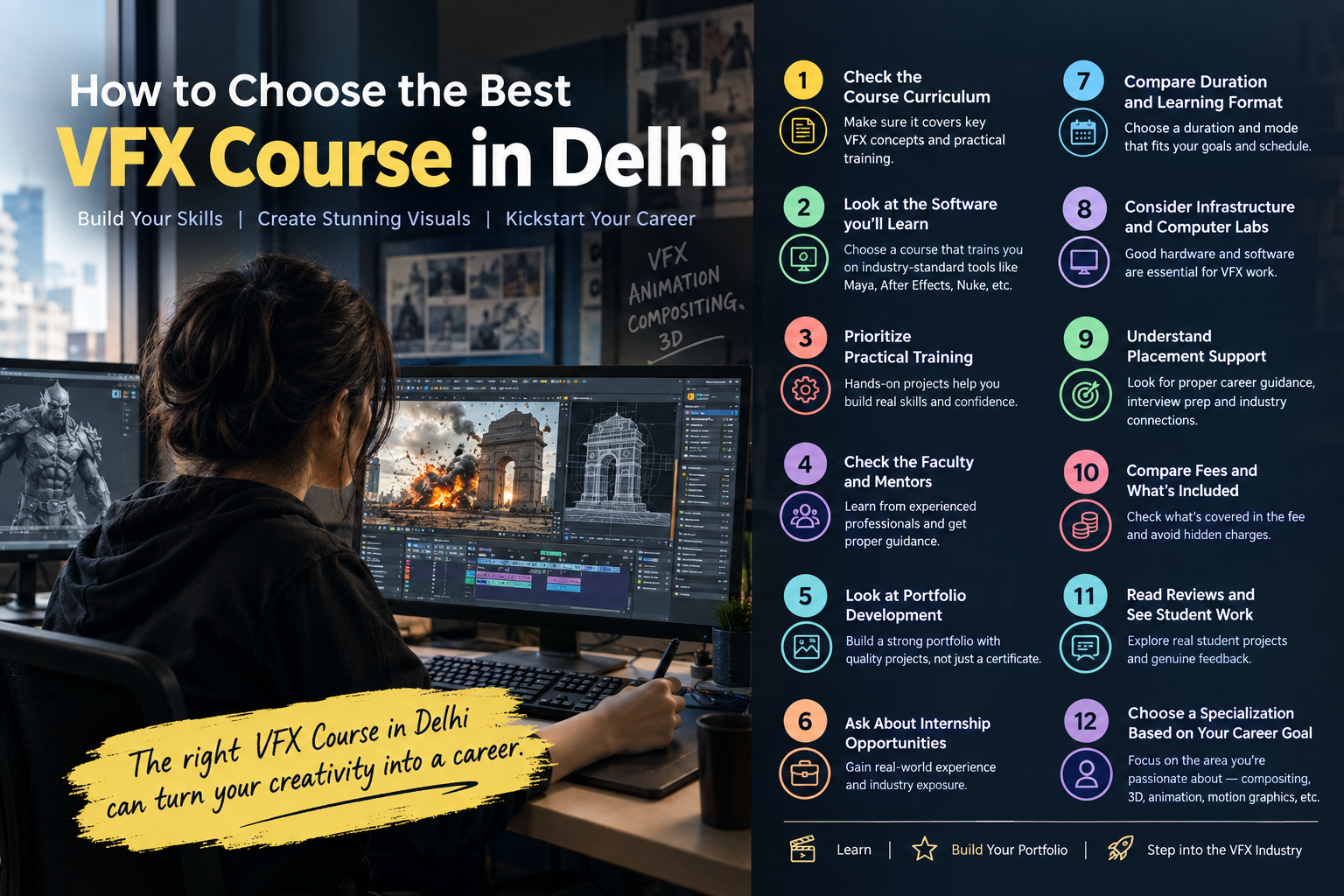
Before taking admission, you should carefully compare the curriculum, faculty, practical training, software, portfolio opportunities, fees, internships, and placement support. Here are the key factors you should consider when choosing a VFX course in Delhi.
1. Check the VFX Course Curriculum
The first thing to examine is the curriculum. A good VFX course should cover the fundamental concepts of visual effects as well as practical production techniques.
Depending on the level of the course, important topics may include:
- VFX fundamentals
- Compositing
- Rotoscoping
- Match moving
- Green screen and chroma keying
- Motion graphics
- 3D modeling
- Texturing
- Lighting and rendering
- 3D animation
- Video editing
- Visual effects production workflow
Do not select a course only because it has a long list of topics. Check whether students actually get enough practical time to work on these areas.
2. Look at the Software of VFX Course you will Learn
VFX artists need to understand industry-standard software and workflows. Therefore, software training should be an important part of your decision.
Depending on the specialization, a VFX Course in Delhi may include tools such as Autodesk Maya, Adobe After Effects, Adobe Premiere Pro, Foundry Nuke, Blender, Photoshop, and other specialized applications.
The exact software you need will depend on the career path you want to pursue. For example, someone interested in compositing may require different tools from someone focusing on 3D modeling or animation.
Instead of choosing an institute simply because it teaches many software programs, check whether you will actually use those tools in practical projects.
3. Prioritize Practical Training of VFX Course
VFX is a skill-based field, so simply watching demonstrations or attending theoretical classes is not enough.
A strong course should give you opportunities to create projects yourself. You should be able to practice techniques such as compositing, object removal, green-screen editing, tracking, 3D integration, and other relevant processes.
Ask the institute how much time students spend working on practical assignments. You can also ask to see examples of student projects.
The quality of practical work can tell you much more about a course than its promotional brochures.
4. Check the Faculty and Mentors of VFX Course
The instructor can have a major impact on your learning experience. Before enrolling, find out who will teach the course and whether they have relevant professional or teaching experience.
A good instructor should be able to explain technical concepts clearly, demonstrate professional workflows, identify mistakes in your work, and provide useful feedback.
If possible, attend a demo class before making a final decision. This can help you understand the teaching style and determine whether the course matches your learning needs.
5. Examine the Portfolio of VFX Course and Development Process
One of the biggest mistakes beginners make is completing a VFX course without building a strong portfolio.
Your portfolio is a collection of your best work that can demonstrate your skills to potential employers or clients. It can include compositing projects, motion graphics, 3D work, animation, video editing, or other relevant projects depending on your specialization.
When comparing a VFX Course in Delhi, ask whether portfolio development is included in the training.
A course should ideally help you create several quality projects instead of giving you only certificates after completing the classes.
6. Ask About Internship Opportunities of VFX Course
An internship can help you understand how professional projects are handled in a real working environment.
Before joining a course, ask whether the institute provides internship opportunities and what the internship actually involves. Find out whether students work on real projects, receive mentorship, and get opportunities to apply their classroom knowledge.
Do not assume that every course mentioning the word “internship” provides meaningful industry exposure. Ask for specific details about its duration, responsibilities, and learning structure.
7. Compare VFX Course Duration and Learning Format
VFX courses can range from short-term programs to longer diploma or advanced training programs. The right duration depends on your existing knowledge, career goals, and the specialization you want to pursue.
A short course may be useful for someone who wants to learn specific software or techniques, while a longer program may be more appropriate for a beginner who wants comprehensive training.
You should also consider whether the course is offline, online, or hybrid. For beginners, practical access to systems and direct guidance can be particularly useful when learning complex VFX workflows.
8. Consider VFX Course Infrastructure and Computer Labs
VFX production requires capable hardware because 3D applications, rendering, compositing, and high-resolution video projects can be resource-intensive.
Before enrolling, visit the institute if possible and check the computer labs, software availability, classroom environment, and other facilities.
Ask whether students get sufficient practice time on the systems. A course may have a good curriculum, but limited access to computers can make practical learning difficult.
9. Understand VFX Course Placement Assistance
If your goal is to get a job after completing your course, placement support may be an important factor.
Ask the institute what kind of placement assistance it provides. Instead of focusing only on advertised placement numbers, ask about the types of companies that recruit students, the roles available, interview preparation, resume support, and portfolio guidance.
Remember that placement assistance does not guarantee employment. Your skills, portfolio, interview performance, and practical knowledge will also influence your career opportunities.
10. Compare VFX Course Fees and What Is Included
Course fees can vary significantly between institutes. However, the cheapest course is not automatically the best choice, and an expensive course does not automatically provide better training.
Compare what is included in the fee, such as:
- Classroom training
- Software training
- Practical lab access
- Projects
- Study materials
- Portfolio development
- Internship opportunities
- Certification
- Placement assistance
Also ask about additional charges before admission so there are no unexpected expenses later.
11. Check Reviews and Student Work
Before choosing a VFX Course in Delhi, research the institute independently. Look at student reviews, social media pages, Google reviews, and publicly available student portfolios.
However, do not depend on reviews alone. Promotional testimonials can provide limited information. Try to evaluate actual student work and, if possible, speak to current or former students.
The quality and variety of student projects can provide a better understanding of what you may realistically achieve during the course.
12. Select a Specialization of VFX course based on your Career Goal
VFX is a broad field. You may eventually specialize in compositing, 3D modeling, animation, motion graphics, lighting, texturing, or other areas.
Therefore, first identify the type of work you find interesting. Then choose a course that provides suitable training and projects in that area.
You do not need to decide your entire career on the first day, but having a direction can help you choose the right training program.
Conclusion
Choosing the best VFX Course in Delhi should not be based only on advertisements, discounts, certificates, or course duration. The more important factors are practical training, curriculum, software exposure, faculty, portfolio development, infrastructure, internship opportunities, and career support.
Before making your decision, compare multiple institutes and, whenever possible, visit them personally. Attend a demo class, inspect the computer labs, ask detailed questions about the curriculum, and review actual student projects.
Most importantly, remember that completing a VFX course is only the beginning. Your skills improve through continuous practice, experimentation, and portfolio development. A course can provide the right environment and guidance, but your consistency and quality of work will ultimately play a major role in building a career in the VFX industry.